

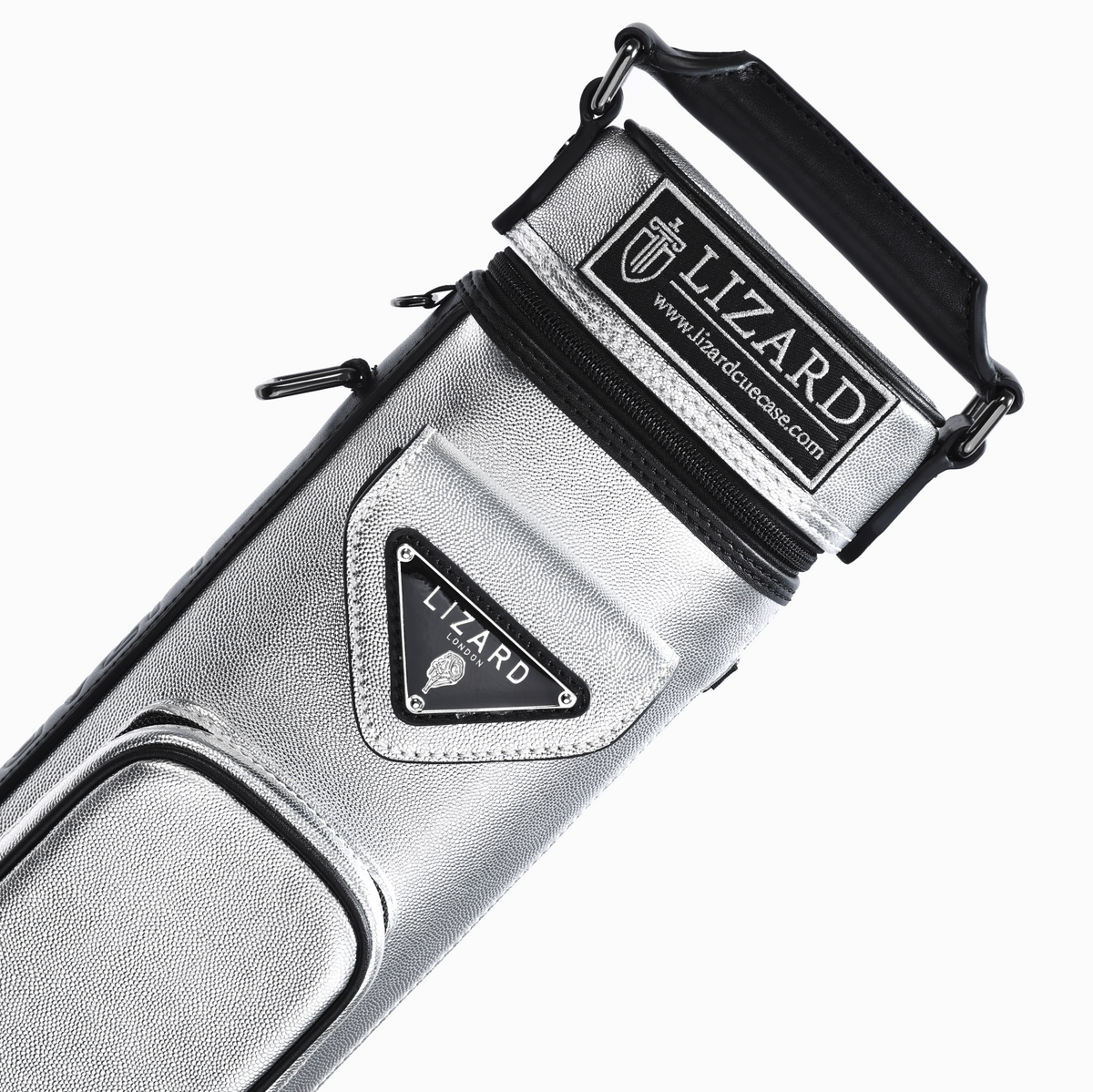
Tournament pool is different from casual play.
When you play at home or visit your local pool hall, you may only need a playing cue and a few basic accessories. Tournament players often carry much more: a playing cue, break cue, jump cue, spare shafts, cue extension, chalk, gloves, joint protectors, and maintenance tools.
That means your pool cue case becomes more than a simple carrying bag.
It needs to protect your equipment, keep everything organized, provide enough capacity, and remain comfortable to carry throughout a long tournament day.
So, what should you look for when choosing a pool cue case for tournaments?
This guide explains the most important factors, including capacity, protection, storage, portability, materials, and organization.
What Makes a Good Tournament Pool Cue Case?
A good tournament pool cue case should balance five important factors:
- Protection
- Storage capacity
- Organization
- Portability
- Durability
The largest cue case is not automatically the best choice.
Likewise, the most expensive case may offer features you do not actually need.
The right tournament cue case should match your playing setup and the way you travel to competitions.
For most tournament players, the goal is simple:
Carry everything you need without carrying unnecessary equipment.
1. Choose the Right Cue Case Capacity
Capacity is one of the first things tournament players should consider.
Pool cue cases are commonly described using combinations such as:
- 2B3S
- 2B4S
- 3B4S
- 3B6S
The letters usually refer to:
B = Butt
S = Shaft
For example:
2B3S
2 cue butts + 3 shafts
This configuration can work for players who carry a playing cue, a break cue, and a few additional shafts.
2B4S
2 cue butts + 4 shafts
This provides additional shaft capacity while maintaining a relatively compact setup.
3B4S
3 cue butts + 4 shafts
This configuration can be useful for tournament players who carry a playing cue, break cue, jump cue, and multiple shafts.
3B6S
3 cue butts + 6 shafts
This is better suited to players who carry a larger equipment setup and several shafts.
The important point is that capacity should follow your equipment.
Do not buy a large cue case simply because it can hold more.
Instead, consider what you actually bring to tournaments.
2. Build Your Tournament Cue Setup Before Choosing a Case
A useful way to choose a cue case is to build your equipment list first.
A tournament player might carry:
Main Cues
- Playing cue
- Break cue
- Jump cue
Shafts
- Primary playing shaft
- Backup shaft
- Break shaft
- Additional shaft
Accessories
- Chalk
- Glove
- Joint protectors
- Cue extension
- Tip tool
- Scuffer
- Cleaning cloth
Once you know what you carry, choosing the case becomes much easier.
For example, a player carrying a playing cue, break cue, jump cue, and several shafts may benefit from a 3B4S or 3B6S configuration.
A player with a simpler setup may find a 2B3S or 2B4S case more practical.
The objective is not maximum capacity.
It is appropriate capacity.
3. Protection Matters More During Tournaments
Tournament equipment is often exposed to more movement than normal.
You may travel by:
- Car
- Train
- Bus
- Airplane
- Taxi
- Rideshare
Your cue case may be placed on the floor, beside other equipment, inside a vehicle, or carried through a crowded venue.
A good cue case should help reduce unnecessary movement and protect individual cue components.
Look for:
- Separate butt and shaft compartments
- Adequate internal padding
- Stable internal dividers
- Secure closure systems
- Reinforced construction
- Protection around joints and sensitive components
The interior structure is particularly important.
A beautiful exterior cannot compensate for poor internal protection.
Your cue should remain secure inside the case instead of moving freely during transportation.
4. Should Tournament Players Choose a Hard or Soft Cue Case?
There is no single answer for every player.
Hard and soft cue cases have different advantages.
Hard Pool Cue Cases
Hard cases generally provide stronger resistance against external pressure.
They can be useful for players who:
- Travel frequently
- Carry expensive cues
- Want stronger structural protection
- Transport equipment over longer distances
The trade-off is that hard cases can be heavier and bulkier.
Soft Pool Cue Cases
A structured soft cue case can provide a good combination of protection and portability.
Soft cases are often easier to:
- Carry
- Store
- Transport
- Fit into vehicles
- Use during local tournaments
A well-constructed soft case can still provide padding, separated compartments, reinforced areas, and organized accessory storage.
The important thing is not simply whether a case is hard or soft.
Look at how the case is actually constructed.
5. Interior Organization Is More Important Than It Looks
Tournament days can become busy.
You may need to change equipment quickly between matches.
A well-organized cue case allows you to find what you need without unpacking everything.
Ideally, your case should separate:
Cue butts
Cue shafts
Accessories
Maintenance tools
For example, chalk and gloves should not be buried underneath cue components.
Your cue extension should have a suitable storage location.
Small tools should have their own pocket.
Joint protectors should be easy to access.
Good organization saves time and reduces unnecessary handling of your equipment.
6. Don’t Forget Accessory Storage
A tournament cue case is rarely carrying only cues.
Players often bring a surprising number of accessories.
These may include:
- Chalk
- Chalk holder
- Glove
- Cue towel
- Tip shaper
- Scuffer
- Joint protectors
- Cue extension
- Small maintenance tools
- Personal items
This is why accessory storage should be considered before buying a cue case.
A case with insufficient pocket space may force you to carry a second bag.
That defeats one of the main advantages of having a larger tournament cue case.
Look for practical pockets rather than simply counting the number of pockets.
A pocket should be large enough for the item it is designed to carry and positioned somewhere that is easy to access.
7. Consider the Weight of the Fully Loaded Case
One common mistake is judging a cue case by its empty weight.
A tournament case may feel light when empty but become significantly heavier after you add:
- Three cue butts
- Four or six shafts
- Accessories
- Extension
- Tools
- Personal items
If you spend several hours walking around a tournament venue, carrying comfort becomes important.
Consider:
- Shoulder strap design
- Handle construction
- Strap adjustment
- Weight distribution
- Padding
- Overall case dimensions
A case should remain comfortable when fully loaded.
8. Think About How You Travel
Your transportation habits should influence your cue case choice.
Local Pool Hall
If you normally drive a short distance to your local pool hall, convenience and quick access may be more important than maximum protection.
Regional Tournaments
If you regularly travel between cities, you may want a stronger structure and better organization.
International Travel
Players who travel internationally should pay particular attention to protection, dimensions, construction, and transportation conditions.
The case should protect the cue while also being practical to carry through airports, hotels, tournament venues, and transportation systems.
Before traveling, always check the transportation provider’s current rules for sports equipment and baggage.
9. Materials Matter, But They Are Not Everything
Players often focus on whether a cue case is made from leather, synthetic materials, microfiber, canvas, or another exterior material.
Material does affect:
- Appearance
- Weight
- Durability
- Maintenance
- Abrasion resistance
- Water resistance
However, the material alone does not determine the quality of a cue case.
Two cases made from different materials can both perform well if their internal structures are properly designed.
When comparing cases, consider the complete construction:
Exterior material + internal padding + compartment structure + hardware + stitching + carrying system
This provides a more useful picture than simply asking which material is the best.
10. Look at Handles, Straps and Hardware
Tournament players often carry their cases for long periods.
That makes handles and straps important.
Check:
- Handle reinforcement
- Shoulder strap attachment points
- Buckles
- Zippers
- Stitching
- Hardware
- Stress points
These components experience repeated use.
A cue case may look excellent when new, but everyday usability depends on the details.
Pay particular attention to the areas where the strap connects to the case.
These points experience significant stress when the case is fully loaded.
11. Match the Case to Your Playing Style
Different players have different equipment requirements.
Casual Tournament Player
You may only carry:
- Playing cue
- Break cue
- Spare shaft
- Basic accessories
A compact 2B3S or 2B4S case may be sufficient.
League Player
You may need:
- Playing cue
- Break cue
- Multiple shafts
- Accessories
A 2B4S configuration can provide additional flexibility.
Competitive Tournament Player
You may regularly carry:
- Playing cue
- Break cue
- Jump cue
- Multiple shafts
- Extension
- Tournament accessories
A 3B4S configuration may provide a more complete setup.
Cue Collector or Advanced Player
If you regularly carry several shafts and multiple cue configurations, a larger case such as a 3B6S may make more sense.
Again, the goal is to match the case to your equipment rather than simply choosing the largest option.
12. What Should You Pack in a Tournament Cue Case?
A practical tournament setup might look like this:
Essential Equipment
- Playing cue
- Break cue
- Jump cue
- Primary shaft
- Backup shaft
Accessories
- Chalk
- Glove
- Joint protectors
- Cue extension
- Cue towel
Maintenance
- Tip tool
- Scuffer
- Cleaning cloth
- Small emergency tools
Personal Items
- Water
- Small towel
- Phone
- Wallet
- Other tournament essentials
The exact setup will depend on your playing style.
The key principle is simple:
Prepare before the match instead of searching for equipment during the match.
13. What Should You Avoid When Buying a Tournament Cue Case?
There are several common mistakes.
Buying Too Small
A case that cannot comfortably accommodate your equipment can become frustrating very quickly.
Avoid forcing additional shafts or cue components into unsuitable compartments.
Buying Too Large
More capacity also means more size and potentially more weight.
If you never carry six shafts, there may be little reason to choose a case designed around that capacity.
Focusing Only on Appearance
Design matters, but protection and organization should come first.
A beautiful case is not useful if the interior does not fit your equipment.
Ignoring the Fully Loaded Weight
Always consider how the case will feel after you put everything inside.
Ignoring Accessory Storage
If you need a separate bag for all your accessories, the cue case may not be serving your setup efficiently.
14. When Should You Upgrade Your Pool Cue Case?
You may want to consider upgrading when:
- You buy a second cue
- You start using a break cue
- You add a jump cue
- You purchase additional shafts
- You begin competing regularly
- Your current case no longer protects your equipment adequately
- You need more accessory storage
- You travel more frequently
- Your current case is uncomfortable to carry
Your cue case should evolve with your equipment.
A player who starts with one cue may eventually need a completely different setup after entering leagues and tournaments.
15. Can You Get a Custom Tournament Pool Cue Case?
For players with unusual equipment requirements, a custom cue case can be an alternative to choosing from standard configurations.
Customization can potentially involve:
- Capacity
- Exterior material
- Interior structure
- Colors
- Logos
- Artwork
- Embroidery
- Hardware
- Accessory pockets
Custom cue cases can also be useful for:
- Professional players
- Cue brands
- Billiard clubs
- Retailers
- Distributors
- Private-label businesses
The advantage of customization is that the case can be designed around the equipment and use case rather than forcing the equipment into a standard configuration.
Tournament Pool Cue Case Checklist
Before buying a tournament cue case, ask yourself:
Equipment
☐ How many cue butts do I carry?
☐ How many shafts do I need?
☐ Do I use a break cue?
☐ Do I use a jump cue?
☐ Do I carry a cue extension?
Protection
☐ Are the cue components separated?
☐ Is the interior adequately padded?
☐ Are the joints protected?
☐ Is the structure stable?
Storage
☐ Does it have enough accessory space?
☐ Can I organize chalk, gloves and tools?
☐ Can I access accessories easily?
Transportation
☐ Is the case comfortable when fully loaded?
☐ Is the shoulder strap adjustable?
☐ Can I easily transport it by car or public transportation?
☐ Is it suitable for the way I travel?
Long-Term Use
☐ Will my equipment collection grow?
☐ Do I need additional shaft capacity?
☐ Would a larger configuration prevent me from replacing the case later?
Final Thoughts
The best pool cue case for tournament players is not necessarily the biggest, heaviest, or most expensive case.
It should provide the right combination of:
Protection + Capacity + Organization + Portability + Durability
Start with your equipment.
Count your cue butts and shafts.
Think about your break cue, jump cue, accessories, and travel habits.
Then choose a cue case that fits your actual playing system.
For many players, a 2B3S or 2B4S case can provide a compact tournament setup. Players carrying a playing cue, break cue, jump cue, and additional shafts may prefer a 3B4S configuration. Players with larger equipment collections may benefit from a 3B6S case.
The right case is the one that protects the equipment you actually use while remaining practical enough to carry throughout the tournament day.
Explore LIZARD’s pool cue case collection to compare different capacities, materials, designs, and configurations.
If you need a custom pool cue case for personal use, a billiard brand, club, distributor, or private-label project, contact LIZARD to discuss your requirements.
Frequently Asked Questions
What size pool cue case is best for tournaments?
It depends on your equipment. A 2B3S or 2B4S case may work for players with a smaller setup, while players carrying playing, break and jump cues may prefer a 3B4S or larger configuration.
Is a hard case better for tournament play?
A hard case generally provides stronger structural resistance, while a padded soft case can be lighter and easier to carry. Your travel habits and protection requirements should determine the choice.
What is a 3B4S pool cue case?
A 3B4S pool cue case is designed around three cue butts and four shafts.
Do tournament players need a jump cue?
Not every player uses a jump cue. If you do carry one, make sure the cue case has suitable capacity and internal compartments.
How many shafts should I carry?
That depends on your playing setup. Some players carry one primary shaft, while others bring backup or alternative shafts. Choose case capacity based on the equipment you actually use.
What accessories should I carry to a pool tournament?
Common accessories include chalk, gloves, joint protectors, cue extensions, tip tools, scuffers, towels, and basic maintenance equipment.
Can I order a custom pool cue case?
Custom cue cases can be designed around different capacities, materials, colors, logos, artwork, storage requirements, and other specifications. Contact the manufacturer to discuss your requirements.
مشاركة:
Pool Cue Case Dimensions: Complete Size & Fit Guide