

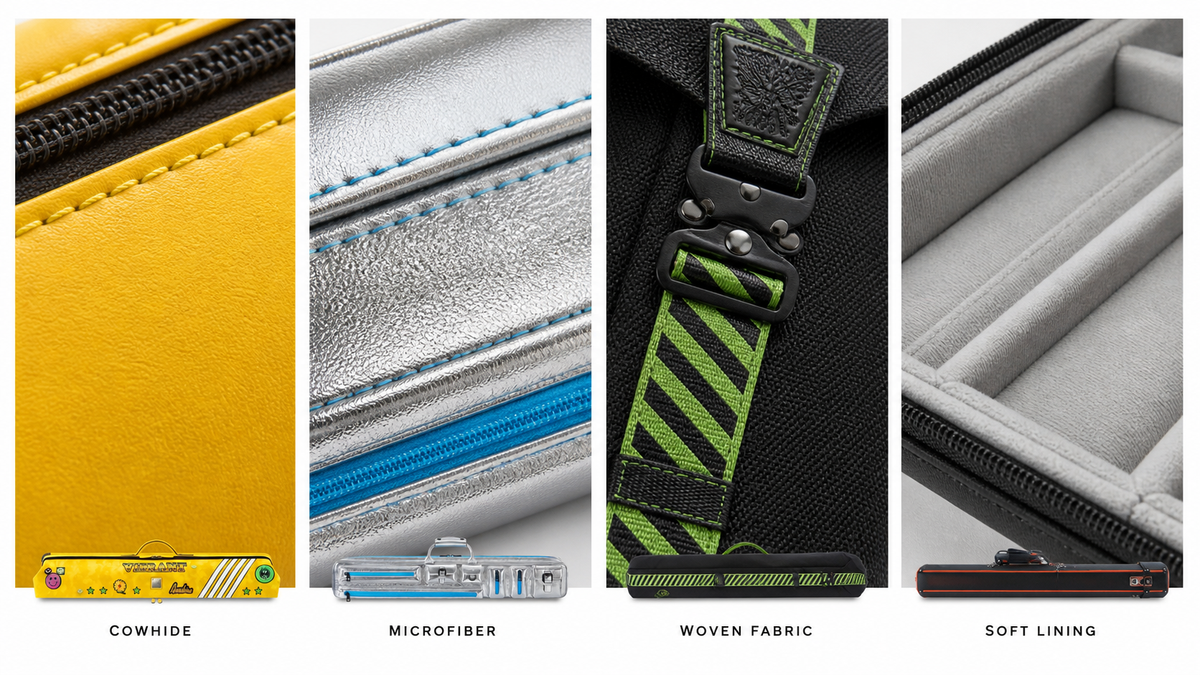
A pool cue is not something most players want to throw into an ordinary bag.
Whether you play casually at your local pool hall, compete in tournaments, or collect custom cues, the case you choose plays an important role in protecting your equipment and making it easier to carry.
That is why a leather pool cue case remains a popular choice among players who want a combination of protection, durability, organization, and style.
But not every leather cue case is designed the same way.
Some prioritize appearance. Others focus on storage capacity, structural protection, portability, or everyday functionality.
So how do you choose the right leather pool cue case?
This guide explains the key factors to consider before buying one.
What Is a Leather Pool Cue Case?
A leather pool cue case is a protective carrying case designed to store and transport pool cue butts, shafts, and billiard accessories.
Depending on the design, a leather cue case may include dedicated compartments for:
- Cue butts
- Cue shafts
- Break cues
- Jump cues
- Joint protectors
- Chalk
- Gloves
- Cue extensions
- Tip tools
- Other billiard accessories
The main advantage is not simply the appearance of leather.
A well-designed leather pool cue case should combine protection, organization, accessibility, and carrying comfort.
Why Choose a Leather Pool Cue Case?
Players choose leather cue cases for different reasons.
For some, it is about aesthetics.
For others, it is about creating a long-term carrying system for valuable pool cues.
Here are several factors that make leather an attractive choice.
1. Premium Appearance
Leather has a distinctive appearance that can make a cue case feel more like a piece of equipment than a simple carrying bag.
For players who care about the visual identity of their equipment, materials, texture, stitching, hardware, and overall construction can make a significant difference.
A cue case is something you may carry into pool halls, tournaments, clubs, and events.
It can become part of your personal playing style.
2. Durability
A quality leather cue case can be designed for regular transportation and long-term use.
However, the quality of the leather alone does not determine durability.
You should also pay attention to:
- Stitching
- Zippers
- Handles
- Shoulder straps
- Hardware
- Internal structure
- Edge protection
- Compartment construction
A beautiful exterior is not enough if the case is difficult to carry or does not protect the cues properly.
3. Better Organization
A good pool cue case should make your equipment easier to organize.
Instead of placing everything into one large compartment, dedicated storage allows you to separate cue butts, shafts, and accessories.
For example, a player may carry:
Playing Cue + Break Cue + Jump Cue + Extra Shafts + Accessories
In this situation, a larger configuration such as a 3B4S cue case can provide considerably more flexibility than a small single-cue case.
Leather Pool Cue Case vs. Standard Cue Bag
One of the most important differences is construction.
A basic cue bag may focus primarily on lightweight transportation.
A premium leather pool cue case can place more emphasis on:
- Material quality
- Structural support
- Interior organization
- Hardware
- Design
- Long-term usability
However, leather does not automatically mean better protection.
The internal construction is just as important as the exterior material.
A well-designed case should keep cue components separated and minimize unnecessary movement during transportation.
How Many Cues Do You Need to Carry?
Before buying a leather pool cue case, look at your actual equipment.
Ask yourself:
How many cue butts do I carry?
How many shafts do I need?
Do I use a break cue?
Do I use a jump cue?
Do I carry multiple shafts?
Do I need space for accessories?
Your answers will help determine the appropriate case capacity.
1 Cue Setup
If you only carry one playing cue and one shaft, a compact case may be sufficient.
This setup is often practical for casual players who mainly travel short distances.
2 Butt / 4 Shaft Setup
A 2x4 pool cue case can be useful for players who have a playing cue, an additional cue, and several shafts.
It provides more flexibility without requiring the size of a larger professional case.
3 Butt / 4 Shaft Setup
A 3x4 pool cue case, also known as a 3B4S cue case, is a popular configuration for players who carry multiple cues.
A possible setup could include:
- Playing cue
- Break cue
- Jump cue
- Additional shafts
This configuration provides a good balance between equipment capacity and portability.
3 Butt / 6 Shaft Setup
Players with larger cue collections may need even more shaft storage.
A 3B6S cue case can provide additional room for multiple shafts while maintaining a relatively organized setup.
The right capacity depends on the equipment you actually use.
More storage is not always better if you rarely use it.
What Should You Look for in a Leather Pool Cue Case?
Before purchasing a leather cue case, consider these seven factors.
1. Interior Protection
The first job of a cue case is protecting your equipment.
Look for:
- Individual compartments
- Padded interiors
- Secure cue positioning
- Separation between butts and shafts
- Protection around sensitive cue components
Your cue case should hold the equipment securely without forcing it into the compartments.
2. Storage Capacity
Do not choose a case based only on how it looks.
Check the actual capacity.
For example:
2B3S
2 cue butts + 3 shafts
2B4S
2 cue butts + 4 shafts
3B4S
3 cue butts + 4 shafts
3B6S
3 cue butts + 6 shafts
Understanding this terminology makes comparing cue cases much easier.
3. Accessory Storage
A player rarely carries only a cue.
You may also need:
- Chalk
- Gloves
- Joint protectors
- Tip tools
- Towels
- Extensions
- Small maintenance tools
A case with practical accessory storage can help keep everything in one place.
4. Carrying Comfort
A leather cue case can become heavy when fully loaded.
Pay attention to:
- Shoulder straps
- Handles
- Weight distribution
- Strap attachment points
- Overall dimensions
If you frequently walk between your car, pool hall, tournaments, or events, carrying comfort becomes especially important.
5. Hardware and Construction
Small components can have a major effect on everyday use.
Check the quality of:
- Zippers
- Buckles
- Handles
- Shoulder straps
- Metal hardware
- Stitching
These components experience repeated stress during transportation.
6. Style and Design
This is where leather cue cases can become more personal.
You may prefer:
- Minimalist designs
- Classic leather styling
- Modern patterns
- Bold colors
- Textured finishes
- Custom designs
Your cue case does not have to look like everyone else’s.
For many players, it becomes part of their identity around the table.
7. Future Equipment
Do not only consider what you own today.
Your equipment collection may grow.
You might eventually add:
- A break cue
- A jump cue
- Additional shafts
- A cue extension
- New accessories
Choosing a case with some additional capacity can prevent you from having to replace it too quickly.
Genuine Leather vs. Synthetic Leather Cue Cases
When shopping for a leather pool cue case, you may encounter different types of leather and leather-like materials.
The important thing is to understand what you are actually buying.
Different materials can offer different combinations of:
- Durability
- Weight
- Texture
- Maintenance requirements
- Price
- Appearance
Instead of choosing a case simply because the product description says “leather,” look at the complete construction of the case.
Material + structure + interior protection + hardware + craftsmanship all contribute to the overall experience.
Hard Leather Cue Case vs. Soft Leather Cue Case
Another consideration is structure.
A more rigid cue case can provide stronger resistance against external pressure.
This can be useful when traveling frequently or transporting valuable equipment.
A softer construction may offer:
- Lower weight
- Easier carrying
- Greater flexibility
- More compact transportation
Neither design is automatically right for every player.
Think about where and how you normally transport your cues.
If you mostly travel from home to a nearby pool hall, portability may matter more.
If you frequently travel to tournaments or transport expensive cues, structural protection may become more important.
Is a Leather Pool Cue Case Worth It?
The answer depends on your equipment and how you play.
If your cue is an important part of your game, your case should be more than a simple container.
A well-designed leather pool cue case can provide:
Protection
Keep cue butts and shafts organized and protected.
Organization
Keep your playing equipment and accessories in one place.
Portability
Make it easier to transport your complete setup.
Style
Give your equipment a distinctive appearance.
Long-Term Use
A well-constructed case can become part of your regular playing setup for years.
The goal is not to buy the most expensive cue case.
The goal is to find a case that matches your equipment, playing habits, transportation needs, and personal style.
How to Choose the Right Leather Pool Cue Case
Before buying, use this simple checklist:
Choose a smaller case if:
- You carry one main cue
- You rarely carry extra equipment
- You mainly play locally
- You prioritize lightweight transportation
Consider a 2x4 case if:
- You carry multiple shafts
- You have an additional cue
- You want more storage without a very large case
Consider a 3x4 case if:
- You use a playing cue, break cue, and jump cue
- You carry multiple shafts
- You regularly play leagues or tournaments
- You want room for your equipment to grow
Consider a 3x6 case if:
- You own several shafts
- You have a larger cue collection
- You want maximum shaft capacity
- You frequently carry a complete equipment setup
Final Thoughts
Choosing a leather pool cue case is about more than choosing a material.
The best case for you should match the way you actually play.
Consider:
- Cue capacity
- Shaft capacity
- Interior protection
- Accessory storage
- Construction
- Carrying comfort
- Material
- Design
- Future equipment needs
If you only carry one cue, you probably do not need an oversized case.
But if you regularly carry a playing cue, break cue, jump cue, multiple shafts, and accessories, a larger configuration such as a 3B4S or 3B6S case may make more sense.
Your cue is an investment in your game.
Your cue case should be designed to protect it while making your time away from the table easier.
Explore Lizard Cue Case collections and find a configuration that fits your equipment and playing style.
共有する:
Pool Cue Shaft Taper Explained: Pro Taper vs. Conical Taper
Hard vs Soft Pool Cue Case: Which One Should You Choose?