

Pool Cue Joint Types Explained: A Practical Guide to Pins, Compatibility and Cue Storage
A pool cue may look relatively simple when it is assembled, but a two-piece cue is actually a carefully engineered system.
The butt and shaft need to connect securely, align correctly, and separate when the player needs to transport the cue. The component responsible for this connection is the cue joint.
For many players, the joint is something they rarely think about until they need a replacement shaft, a second shaft, a different cue butt, or a joint protector.
Then an important question appears:
Will this shaft actually fit my cue?
The answer is not always obvious.
Pool cues use a variety of joint systems. Common examples include threaded systems such as 5/16×14, 5/16×18, and 3/8×10, as well as proprietary or branded systems such as Uni-Loc and Radial. Even when two joints appear similar, differences in thread specification, pilot geometry, joint-face dimensions, or manufacturer-specific construction can affect compatibility.
Understanding the joint on your cue can therefore save you from choosing the wrong shaft or accessory.
It can also help you understand why a properly designed cue case should protect not only the shaft and butt, but also the connection points between them.
What Is a Pool Cue Joint?
A pool cue joint is the connection system between the butt and shaft of a two-piece cue.
When the cue is assembled, the joint brings the two sections together and keeps them aligned during play.
Depending on the design, a joint can include several components:
-
Joint pin
-
Thread or locking mechanism
-
Shaft insert
-
Joint collar
-
Joint face
-
Pilot or alignment section on some designs
The exact construction varies between cue makers and joint systems.
The joint therefore is not simply a screw.
It is a precision connection between two sections of the cue.
Why Are There So Many Pool Cue Joint Types?
There is no single universal joint standard used across all pool cues.
Different manufacturers and cue makers have adopted different approaches over time.
Some use traditional threaded systems.
Others use quick-release systems.
Some use piloted designs.
Others use flat-faced joints.
There are also proprietary joint systems developed by individual manufacturers.
This variety gives cue makers different ways to approach construction, assembly, maintenance, and player preference.
However, it also creates an important practical issue:
Joint compatibility is not universal.
A shaft designed for one joint specification should not be assumed to fit another simply because the two joints look similar.
What Does 5/16×14 Mean?
5/16×14 is a common cue joint specification.
The first number describes the nominal diameter of the pin:
5/16 inch
The second number refers to:
14 threads per inch
In other words, 5/16×14 describes both the approximate pin diameter and the thread pitch.
This is important because another joint may also use a 5/16-inch pin but have a different thread count.
For example:
5/16×14 ≠ 5/16×18
The diameter is similar, but the thread specification is different.
Therefore, these two systems should not be treated as interchangeable.
When purchasing a replacement shaft, identifying the exact joint specification is essential.
What Does 5/16×18 Mean?
A 5/16×18 joint uses a nominal 5/16-inch pin diameter with 18 threads per inch.
At first glance, it can look very similar to a 5/16×14 joint.
That is exactly why players sometimes confuse the two.
The difference is the thread pitch.
A 5/16×14 joint has 14 threads per inch.
A 5/16×18 joint has 18 threads per inch.
The two specifications are therefore mechanically different.
If you are ordering a replacement shaft, do not rely only on the appearance of the pin.
Confirm the actual joint specification for your cue.
What Is a 3/8×10 Cue Joint?
A 3/8×10 joint uses a nominal 3/8-inch pin with 10 threads per inch.
Compared with a 5/16-inch joint, the nominal pin diameter is larger.
3/8×10 is another widely encountered cue joint specification, particularly among American-style production and custom cues.
However, even when a shaft is advertised as “3/8×10,” players should not automatically assume that every 3/8×10 shaft will fit every cue described that way.
Other dimensions and joint construction can also matter.
For example, joint face geometry and pilot configuration can affect the final fit.
This is why exact specifications are more reliable than relying on a general joint name alone.
What Is a Radial Cue Joint?
Radial is a different type of cue joint system and should not simply be treated as another way of writing a standard 3/8 or 5/16 specification.
Predator describes its Uni-Loc Radial system as a threaded joint using a specialized pin geometry.
The important point for players is compatibility.
A shaft made for a Radial system requires the appropriate matching joint configuration.
It should not be selected simply because the pin appears visually similar to another threaded joint.
When shopping for a replacement shaft, always verify whether the cue uses the exact Radial configuration specified by the shaft manufacturer.
What Is a Uni-Loc Joint?
Uni-Loc is a branded joint system associated with quick-release and Radial configurations.
One of the main practical advantages of a quick-release system is faster assembly and disassembly.
Predator's current joint information describes Uni-Loc Quick-Release as a system that can be assembled in approximately one and a half turns, while the Uni-Loc Radial uses a different threaded design.
For players who frequently assemble and disassemble their cue, a quick-release design can be convenient.
However, “quick release” does not mean that every quick-release joint is interchangeable.
Different manufacturers can use their own proprietary systems.
Therefore:
Quick-release is a design category, not a universal compatibility standard.
Piloted vs Flat-Faced Cue Joints
Another important distinction is the way the joint faces meet.
Some cue joints are described as piloted.
A piloted joint uses an additional alignment section that fits into a corresponding recess.
Other designs are flat-faced, where the mating surfaces meet without the same type of pilot.
The distinction can matter when selecting a replacement shaft.
Two shafts may share the same nominal thread specification but still have different joint-face or pilot configurations.
For this reason, players should consider the complete joint geometry rather than looking only at the pin size.
Are Pool Cue Shafts Interchangeable?
Not automatically.
This is one of the most important things to understand about pool cue equipment.
A replacement shaft needs to match the cue butt's joint configuration.
At minimum, you need to consider:
-
Joint type
-
Pin or connection specification
-
Thread pitch where applicable
-
Pilot configuration
-
Joint-face geometry
-
Collar dimensions
-
Manufacturer-specific design
A brand name alone may not always be enough because manufacturers can use multiple joint systems across different models or production periods.
This means that buying a shaft simply because it is advertised for the same brand can still be risky.
The safest approach is to verify the exact cue model and joint configuration.
Why 5/16×14 and 5/16×18 Should Not Be Confused
This is one of the easiest mistakes to make.
Both systems use a nominal 5/16-inch pin diameter.
But:
5/16×14 = 14 threads per inch
5/16×18 = 18 threads per inch
Because the diameter is the same, the two can appear similar.
However, the thread pitch is different.
A shaft designed for one should not be forced onto the other.
Trying to make incompatible threads engage can damage the joint components.
If you are unsure about the joint, stop before applying force and verify the specification.
How Can You Identify Your Pool Cue Joint?
The safest way to identify a joint is to verify it using reliable information about the specific cue.
Start with the manufacturer's specifications.
If documentation is unavailable, inspect the joint itself.
You can look at:
-
The pin shape.
-
The apparent diameter.
-
The thread pattern.
-
Whether the joint uses a pilot.
-
Whether the joint is flat-faced.
-
The collar configuration.
-
Any markings or model information.
For threaded joints, measurement tools can also help distinguish different specifications.
However, visual identification alone can be unreliable.
If you are purchasing an expensive replacement shaft, confirming the joint specification with the cue manufacturer, shaft manufacturer, or a qualified cue professional is preferable.
Why the Cue Joint Should Be Kept Clean
The cue joint is a precision connection.
Dirt, chalk residue, dust, or debris can interfere with proper seating or make assembly less smooth.
This does not mean the joint should be aggressively polished or modified.
Instead, players should follow the manufacturer's maintenance instructions.
Avoid applying random lubricants, abrasive products, or chemicals unless they are specifically recommended for the joint.
A clean joint is easier to inspect and less likely to accumulate unnecessary contamination.
Do Not Force a Cue Joint
One of the simplest rules of cue maintenance is:
Never force a joint that does not fit correctly.
If a shaft does not thread smoothly onto the butt, stop.
Do not continue turning harder.
Do not attempt to force different thread standards together.
Do not assume that resistance means the parts simply need more pressure.
A damaged joint can be expensive to repair and may affect the usability of the cue.
If the compatibility is uncertain, verify the specifications before continuing.
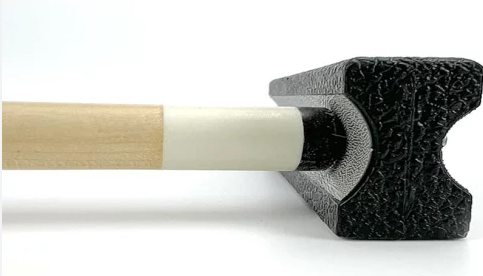
Why Joint Protectors Matter
When a two-piece cue is disassembled, the joint becomes exposed.
A joint protector is designed to cover and protect the exposed joint areas during storage and transportation.
Depending on the cue design, protectors may help reduce contact with:
-
Dust
-
Dirt
-
Scratches
-
Accidental impact
-
Contact with other equipment
Joint protectors are especially useful when the cue is outside the case during assembly, maintenance, or transportation.
However, they should not be considered a replacement for a proper cue case.
The two serve different purposes.
A joint protector protects the exposed connection surfaces.
A cue case protects and transports the complete cue system.
How Should a Cue Joint Be Stored Inside a Cue Case?
Once the cue has been disassembled, the joint should be positioned so that it does not experience unnecessary contact with other hard objects.
A well-designed pool cue case should provide separate storage for cue butts and shafts.
Players should also avoid placing metal tools, keys, or other hard objects directly against exposed cue joints.
If joint protectors are available and appropriate for the cue, they can provide an additional layer of protection.
The basic principle is simple:
Keep the joint clean, protected, and separated from unnecessary contact.
How Joint Knowledge Helps When Choosing a Cue Case
Understanding your cue joint can also improve how you use your cue case.
If you carry multiple shafts, you may have several exposed joint interfaces when assembling and disassembling your equipment.
A case with properly designed internal compartments can help prevent shafts and butts from knocking against one another.
This becomes increasingly useful for players carrying:
-
Multiple shafts
-
Playing cue
-
Break cue
-
Jump cue
-
Spare shafts
-
Joint protectors
The case does not need to be designed around a specific joint standard.
Instead, it should provide secure physical storage for the components of the player's equipment.
Joint Protection During Travel
Travel creates additional opportunities for accidental contact.
A cue may be removed from its case several times during a trip.
It may be assembled in a hotel, pool hall, tournament venue, or practice room.
During these moments, the exposed joint can come into contact with tables, bags, clothing, or other equipment.
A simple travel routine can reduce unnecessary risk:
Before assembly
Remove the joint protector carefully.
During play
Place the protector somewhere secure rather than leaving it loose on the floor or table.
After play
Clean the joint if necessary and reinstall the protector.
During transportation
Return the cue components to their designated case compartments.
Small habits like these can prevent avoidable damage.
Does the Joint Type Change How a Cue Feels?
Players often discuss joint construction when describing the feel or feedback of a cue.
Joint construction can be one factor in how a cue is engineered and how it feels to an individual player.
However, it would be misleading to claim that one joint type automatically produces a universally better hit.
Cue feel depends on many variables, including:
-
Shaft construction
-
Shaft taper
-
Shaft diameter
-
Materials
-
Cue construction
-
Joint construction
-
Tip
-
Ferrule
-
Weight and balance
-
Player technique
Different players may prefer different combinations.
Therefore, joint type should be understood as one part of the overall cue design rather than a standalone measurement of quality.
Common Pool Cue Joint Mistakes
Mistake 1: Assuming Similar Appearance Means Compatibility
Two joints may look similar while using different specifications.
Always verify the exact joint.
Mistake 2: Confusing 5/16×14 With 5/16×18
The diameter is similar, but the thread pitch is different.
Mistake 3: Assuming One Brand Uses Only One Joint
Manufacturers can use different joint systems across models and production periods.
Mistake 4: Ignoring the Pilot
Thread size alone may not describe the complete joint geometry.
Mistake 5: Forcing an Unmatched Shaft
If the shaft does not fit smoothly, stop and verify compatibility.
Mistake 6: Leaving the Joint Unprotected
When the cue is disassembled, an exposed joint is more vulnerable to accidental contact and contamination.
A Practical Pool Cue Joint Checklist
Before buying a replacement shaft or changing your cue setup, check:
Joint Identification
-
What joint system does the cue use?
-
What is the pin specification?
-
Is it threaded or quick-release?
-
Is it piloted or flat-faced?
-
Does the manufacturer specify a particular joint version?
Shaft Compatibility
-
Does the shaft manufacturer list your exact joint?
-
Does the joint geometry match?
-
Is the collar configuration compatible?
-
Are there model-specific differences?
Storage
-
Are the exposed joints protected?
-
Are joint protectors installed when appropriate?
-
Are cue components separated inside the case?
-
Are hard accessories kept away from exposed joint surfaces?
Maintenance
-
Is the joint clean?
-
Is assembly smooth?
-
Are there signs of damage?
-
Are you following the manufacturer's maintenance instructions?
These checks are simple, but they can prevent expensive mistakes.
Frequently Asked Questions
What are the most common pool cue joint types?
Common pool cue joint systems include threaded specifications such as 5/16×14, 5/16×18, and 3/8×10, as well as branded or proprietary systems such as Uni-Loc and Radial. Exact availability varies by manufacturer and cue model.
What does 5/16×14 mean on a pool cue?
It generally indicates a nominal 5/16-inch pin diameter with 14 threads per inch.
What does 5/16×18 mean?
It indicates a nominal 5/16-inch pin diameter with 18 threads per inch.
Are 5/16×14 and 5/16×18 interchangeable?
No. They use different thread pitches and should not be treated as interchangeable.
What does 3/8×10 mean?
It generally refers to a 3/8-inch nominal pin diameter with 10 threads per inch.
Is Radial the same as 3/8×10?
No. Radial is a distinct joint system and should not be treated as simply another name for 3/8×10.
Is Uni-Loc compatible with every quick-release cue joint?
No. Quick-release is a broad design concept, while individual systems can have proprietary specifications. The exact joint must be matched.
Can any pool cue shaft fit any cue butt?
No. The shaft and butt need compatible joint specifications and geometry. Brand, model, production period, joint type, thread specification, pilot, and other dimensions may all matter.
How do I find out what joint my cue has?
Start with the cue manufacturer's specifications or documentation. If that information is unavailable, inspect the joint and consult a qualified cue professional before purchasing a replacement shaft.
Should I use joint protectors?
Joint protectors are useful for protecting exposed joint areas when a two-piece cue is disassembled. They should be used appropriately for the specific cue and together with suitable storage.
Can I put a different shaft on my cue if the pin looks similar?
Do not rely on appearance alone. Similar-looking joints can have different thread pitches or other incompatible dimensions. Confirm the exact joint specification first.
Does the joint type determine cue quality?
No. Joint type is only one part of cue construction. Shaft design, materials, taper, tip, balance, construction quality, and player preference all contribute to the overall cue.
Final Thoughts
The joint may be one of the smallest parts of a pool cue, but it plays an important role in connecting the equipment's two main sections.
Understanding joint types is especially useful when buying replacement shafts, carrying multiple cue setups, maintaining equipment, or selecting joint protectors.
The most important rule is simple:
Do not assume compatibility. Verify it.
A 5/16×14 joint is not the same as a 5/16×18 joint. A Radial system is not simply another name for a standard threaded joint. A quick-release system is not automatically compatible with every other quick-release design.
The exact specifications matter.
For cue owners, proper joint care is equally straightforward. Keep the connection clean, avoid forcing incompatible components, use appropriate joint protection when the cue is disassembled, and store cue components securely inside a suitable case.
A well-designed cue case provides the physical protection needed during storage and transportation, while good equipment knowledge helps players make better decisions about their cues.
At LIZARD, we believe protecting a cue means understanding the complete equipment system—from the shaft and butt to the smallest connection points between them.
Because when every component is designed, handled, and stored with care, the equipment is better prepared for the moment that matters most: the next shot.
Share:
How Weather and Humidity Affect Pool Cues: A Practical Guide to Cue Storage