

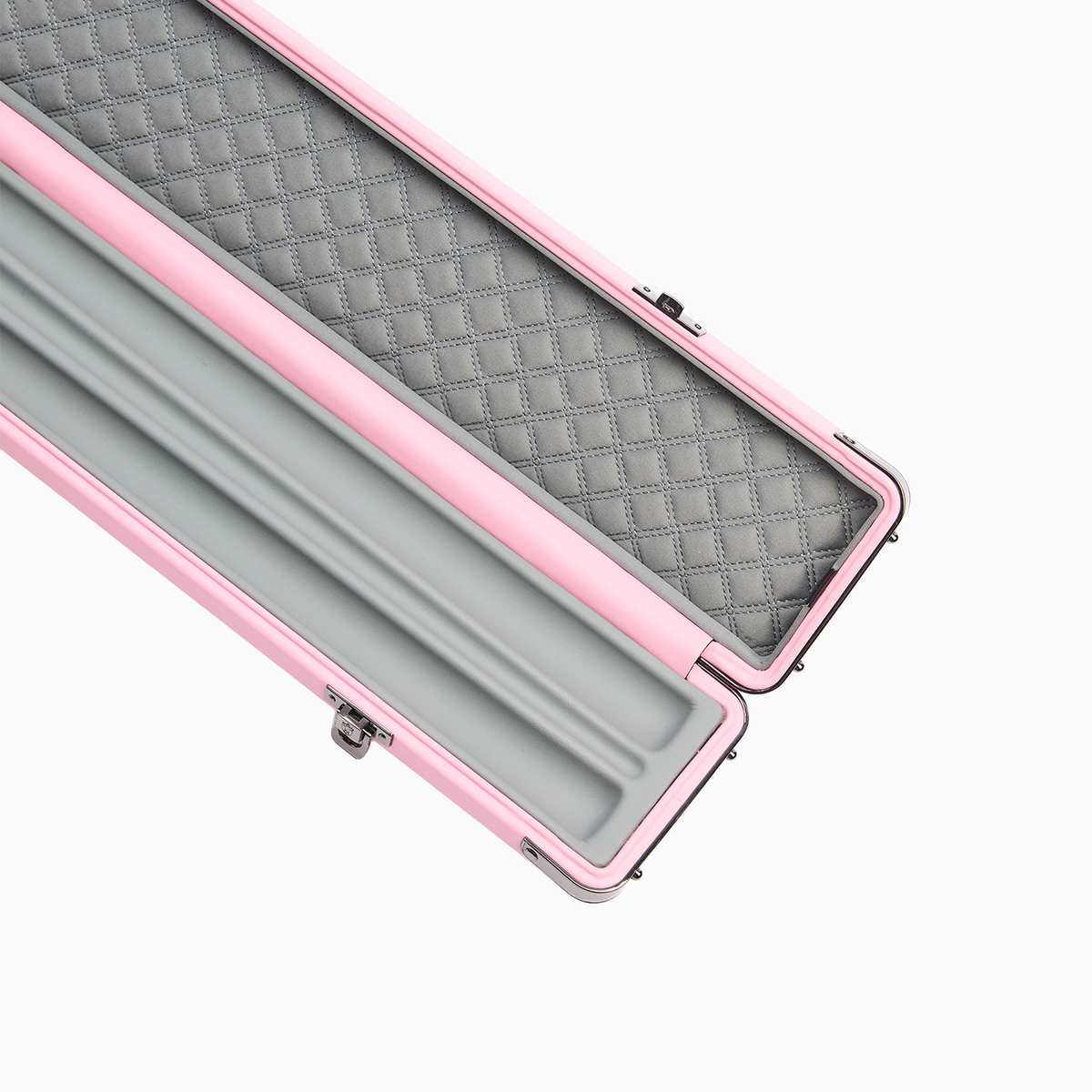
Choosing a pool cue case is not only about how many cues it can hold.
Before buying a cue case, you should also check the case dimensions, internal compartments, cue length compatibility, shaft capacity, and accessory storage.
A case may be advertised as a 2x4, 3x4, or 3x6, but that capacity number does not tell you everything about how the case will fit your equipment.
If you have a standard two-piece pool cue, multiple shafts, a break cue, or a jump cue, understanding pool cue case dimensions can help you choose the right case without carrying unnecessary weight or running out of storage space.
In this guide, we explain the most important pool cue case measurements and how to choose the right size for your equipment.
What Are Pool Cue Case Dimensions?
Pool cue case dimensions generally refer to the external length, width, and height or depth of the case.
However, three different measurements are important:
- External case dimensions
- Internal storage dimensions
- Individual compartment dimensions
The external dimensions tell you how large the case is when carrying or storing it.
The internal dimensions determine whether your cue butts and shafts can fit comfortably.
The compartment dimensions are particularly important because a case may have enough overall space but still have individual tubes or sections that are not suitable for your equipment.
For this reason, do not choose a pool cue case based only on the number printed in the product name.
How Long Should a Pool Cue Case Be?
Most two-piece pool cues are designed around a standard playing length, but the exact dimensions can vary depending on the cue construction, joint system, extensions, and case design.
A cue case should provide enough internal length for your cue components without forcing them into the case.
When checking a pool cue case, consider:
- Cue butt length
- Shaft length
- Joint protector size
- Jump cue components
- Cue extensions
- Internal padding
- Closure design
If you use an extension or unusually long cue component, check the manufacturer’s internal measurements before ordering.
A slightly longer case is generally easier to work with than one that is too short.
Does a 58-Inch Pool Cue Fit in a Cue Case?
A 58-inch pool cue is commonly used as a reference when discussing standard pool cue length.
However, a two-piece cue is separated into a butt and shaft for transportation.
Therefore, you should not simply compare the total 58-inch cue length with the external length of the case.
Instead, check the maximum component length supported by the cue case.
For example, a case may have an external length of around 32 inches while still being capable of carrying a standard two-piece cue because the cue is separated into two sections.
The important measurement is the available internal compartment length.
Understanding 2B3S, 2B4S and 3B4S Cue Case Capacity
Pool cue cases are often described using abbreviations such as 2B3S or 3B4S.
The terminology is simple:
B = Butt
S = Shaft
Therefore:
|
Cue Case |
Capacity |
|---|---|
|
1B1S |
1 butt + 1 shaft |
|
2B3S |
2 butts + 3 shafts |
|
2B4S |
2 butts + 4 shafts |
|
3B4S |
3 butts + 4 shafts |
|
3B6S |
3 butts + 6 shafts |
For example, a 3B4S pool cue case is designed around three cue butts and four shafts.
That can provide enough space for a playing cue, break cue, jump cue, and additional shafts depending on the player’s setup.
However, capacity does not always mean that every compartment can be used for every type of cue component.
Always check the actual internal layout of the case.
2B3S vs 2B4S: What Is the Difference?
The difference is one additional shaft.
A 2B3S case provides storage for:
- 2 cue butts
- 3 cue shafts
A 2B4S case provides:
- 2 cue butts
- 4 cue shafts
If you regularly carry multiple shafts, the additional shaft capacity can be useful.
If your equipment setup is smaller, however, a more compact case may be easier to carry.
The best capacity depends on your actual equipment rather than simply choosing the largest available case.
3B4S vs 3B6S: Which Size Do You Need?
The main difference is shaft capacity.
A 3B4S case can hold:
- 3 cue butts
- 4 shafts
A 3B6S case can hold:
- 3 cue butts
- 6 shafts
A 3B6S case may be useful for players who carry multiple playing shafts, backup shafts, or different shaft setups.
For players who only need a playing cue, break cue, jump cue, and a few spare shafts, a 3B4S configuration may provide enough capacity without adding unnecessary storage.
Don’t Forget Accessory Storage
Pool players rarely carry only cues.
Your equipment may also include:
- Chalk
- Cue gloves
- Joint protectors
- Tip tools
- Cue towels
- Extensions
- Jump cue components
- Maintenance tools
- Small personal items
This is why two cue cases with the same cue capacity can provide very different storage experiences.
When comparing pool cue cases, look at both the cue compartments and accessory pockets.
A case with practical accessory storage can eliminate the need for carrying a separate small equipment bag.
Pool Cue Case Size Guide
Here is a simple way to think about cue case capacity:
1B1S
Best for players who carry one playing cue and want a compact setup.
2B3S
A good option for players who carry a playing cue, a second cue, and additional shaft capacity.
2B4S
Suitable for players who need two cue butts and several shafts.
3B4S
Designed for players with a more advanced equipment setup, such as a playing cue, break cue, jump cue, and additional shafts.
3B6S
Useful for players who carry multiple shafts and want additional storage for a larger setup.
The goal is not to choose the largest case.
The goal is to choose the smallest case that comfortably fits the equipment you actually use.
How to Measure Your Cue Before Buying a Case
If you already own a cue, you can check several measurements before purchasing a case.
Step 1: Separate the Cue
If you use a two-piece cue, separate the butt and shaft.
Step 2: Measure Each Component
Measure the length of the butt and shaft individually.
Step 3: Include Joint Protectors
If you normally use joint protectors, include them when checking the available space.
Step 4: Check Additional Equipment
If you carry a jump cue, extension, or extra shaft, measure these components as well.
Step 5: Compare With the Case Specifications
Compare your measurements with the manufacturer’s internal compartment dimensions.
Do not rely only on the external case dimensions.
What Other Dimensions Should You Consider?
Length is only one part of the equation.
You should also consider:
Case Width
A wider case may provide additional storage space but can also be bulkier.
Case Depth
Depth becomes more important with hard or structured cases and larger equipment configurations.
Weight
A larger case filled with multiple cues and accessories can become surprisingly heavy.
Pocket Size
Accessory pockets should be large enough for the equipment you actually carry.
Strap Length
If you frequently walk to pool halls, leagues, or tournaments, shoulder strap comfort can make a significant difference.
Should You Buy a Larger Pool Cue Case?
Not necessarily.
A larger cue case provides more capacity, but more storage can also mean:
- Higher weight
- Larger overall size
- More bulk during transportation
- More unused space
If you currently carry one playing cue and one break cue, buying a large 3B6S case may provide more capacity than you need.
On the other hand, if you regularly purchase additional shafts or carry a jump cue, choosing a case with some extra capacity may save you from replacing your case later.
Think about your current setup and your likely equipment needs over the next few years.
How to Choose the Right Pool Cue Case Size
Before buying, ask yourself five questions:
1. How many cue butts do I carry?
2. How many shafts do I need?
3. Do I carry a break cue or jump cue?
4. Do I use a cue extension?
5. How many accessories do I normally bring to the pool hall?
Once you answer these questions, choosing a cue case becomes much easier.
For example:
Playing cue + break cue + spare shafts
→ Consider a 2B4S configuration.
Playing cue + break cue + jump cue + additional shafts
→ Consider a 3B4S configuration.
Multiple cues + several shafts + extensive accessories
→ Consider a larger 3B6S configuration.
Final Thoughts
The right pool cue case is not necessarily the biggest or most expensive one.
It should fit your cue components securely, provide enough capacity for your current setup, protect your equipment during transportation, and give you enough room for the accessories you actually use.
Before purchasing, check the case’s internal dimensions, cue capacity, accessory storage, weight, and carrying system.
Understanding pool cue case dimensions can help you avoid buying a case that is either too small for your equipment or unnecessarily large for your needs.
Explore LIZARD pool cue cases to find configurations designed for different cue setups, including 2B3S, 3B4S, and larger capacity options.
Share:
2B3S vs 2B4S vs 3B4S Pool Cue Case: Which Size Do You Need?
Best Pool Cue Case for Tournament Players: What to Look For